The Gap Between When Autism Can Be Caught — and When It Usually Is
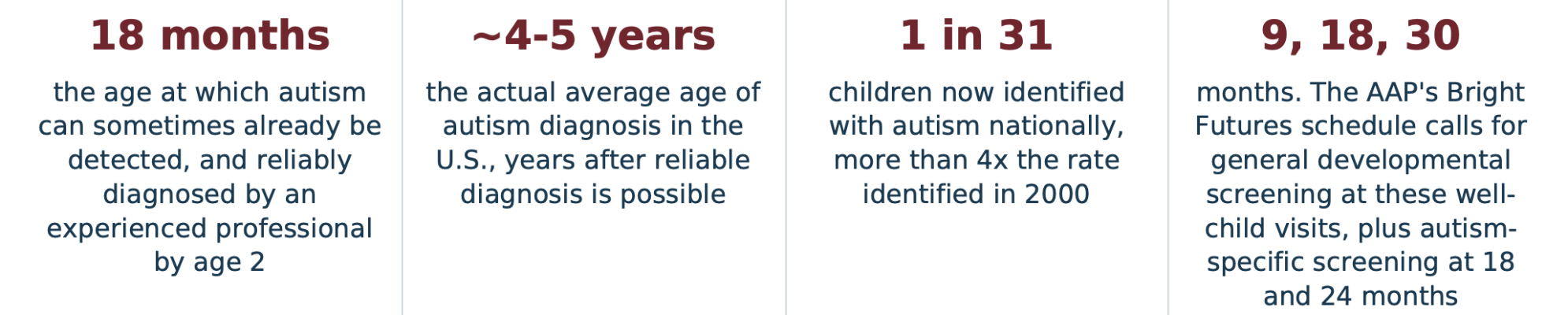
The numbers tell a stark story. The CDC states plainly that autism can sometimes be detected at 18 months, and that a diagnosis made by an experienced professional by age 2 is considered reliable. That’s the science. The reality looks different.
Research tracking actual diagnosis records consistently finds the average child isn’t diagnosed until age 4 or 5. Shattuck et al. (2009), using a record-review methodology, placed the median age even higher — at 5.5 years. And that’s not the whole delay. Separate research found that even after a developmental concern is formally raised, the average time between a child’s first evaluation and their eventual autism diagnosis stretches another 13 months. Add it up, and many families are losing two to three years of intervention time that science says didn’t have to be lost.
The mechanism for closing that gap already exists. The American Academy of Pediatrics’ Bright Futures schedule calls for general developmental screening at the 9-, 18-, and 30-month well-child visits, plus autism-specific screening at 18 and 24 months. The primary tool used at those visits — the M-CHAT-R/F — carries real predictive weight: among children who screen positive and complete the follow-up interview with persistent deficits, 47% go on to receive an autism diagnosis specifically, and 95% receive some form of developmental or behavioral diagnosis overall. That’s not noise in the data. That’s meaningful signal.
And implementation at scale is achievable. One large-scale intervention documented 91% screening completion across 26,000 children — proof that consistent screening isn’t just clinically sound, it’s operationally realistic. The tools work. The schedule works. What has to work is showing up for the visits.
The urgency behind all of this is compounded by one additional fact: autism prevalence among 8-year-olds has more than quadrupled since 2000, moving from 1 in 150 children to 1 in 31 as of the CDC’s most recent 2022 surveillance data. More children are on a trajectory that structured screening is positioned to identify. Every skipped or indefinitely rescheduled well-child visit makes that trajectory harder to intercept.
3 Takeaways for Families in Forsyth, Gwinnett, Hall, Dawson, Cherokee & Fulton Counties
1. The 18- and 24-Month Visits Are Non-Negotiable
These are the two visits where autism-specific screening is scheduled under AAP guidelines. A child who misses them doesn’t get that screening window back at a later visit. Even when development looks typical to parents and caregivers, these visits exist precisely to catch what isn’t yet visible without a structured tool.
2. A Positive Screen Is a Starting Point — Not a Verdict
A positive M-CHAT result is not an autism diagnosis. It’s a prompt for further evaluation — and a meaningful one. Among children who screen positive with persistent deficits on follow-up, 95% go on to receive some developmental or behavioral diagnosis. That result is worth taking seriously and following through on quickly, because the 13-month average delay between first evaluation and diagnosis means starting early matters.
3. Don’t Wait for the Next Scheduled Visit If Something Feels Off
The AAP’s well-child schedule is a floor, not a ceiling. Concerns about language, social responsiveness, eye contact, or behavior — raised between scheduled visits — should come up at any appointment. Waiting until the next milestone visit costs time that research consistently links to worse long-term outcomes.
“Every skipped or indefinitely rescheduled well-child visit is a missed opportunity to catch something that is both catchable and, when caught early, far more responsive to intervention. The research doesn’t leave much room for ambiguity: earlier identification changes outcomes, the tools to enable it exist, and the visit schedule is the structure that makes it possible.”
— Dr. Hiral Lavania, One Family Pediatrics
That framing matters. This isn’t a story about medicine being behind the science — the AAP issued guidance on autism-specific screening more than two decades ago. This is a story about what happens when a structured process isn’t followed consistently. The data from large-scale screening programs shows 91% completion rates are achievable across populations of 26,000 children. The gap between what’s possible and what’s happening isn’t a knowledge problem. It’s an access and consistency problem — and it’s one that a committed pediatric practice, and an engaged family, can directly address.
About the Study
Why the Well-Child Visit Schedule Matters was prepared by One Family Pediatrics as part of its North Atlanta Family Health Series, serving families across Forsyth, Gwinnett, Hall, Dawson, Cherokee, and Fulton Counties. The report draws exclusively on federal surveillance data, peer-reviewed research, and clinical guidance from the CDC and the American Academy of Pediatrics. No proprietary data was collected and no original statistical analysis was conducted. All prevalence figures are drawn from the CDC’s ADDM Network surveillance cycles. Screening performance data reflects published M-CHAT-R/F research. The report is intended to inform families, not to provide individualized medical advice.
Frequently Asked Questions
Q: At what age can autism actually be detected? The CDC states that autism can sometimes be detected as early as 18 months, and that a diagnosis made by an experienced professional by age 2 is considered clinically reliable. Despite this, the average American child isn’t diagnosed until age 4 or 5 — and one study tracking actual medical records placed the median diagnosis age at 5.5 years.
Q: What is the M-CHAT, and does it actually work? The M-CHAT-R/F (Modified Checklist for Autism in Toddlers, Revised with Follow-Up) is the primary autism screening tool used at the 18- and 24-month well-child visits under AAP guidelines. Among children who screen positive and complete the follow-up interview with persistent deficits, 47% go on to receive an autism diagnosis specifically, and 95% receive some form of developmental or behavioral diagnosis. A positive screen is not a diagnosis — it’s a signal for further evaluation.
Q: Which well-child visits include developmental and autism screening? Under the AAP’s Bright Futures periodicity schedule, general developmental screening is conducted at the 9-, 18-, and 30-month visits. Autism-specific screening is added at the 18- and 24-month visits. One Family Pediatrics follows this schedule at every well-child visit.
Q: How common is autism today compared to previous years? According to the CDC’s Autism and Developmental Disabilities Monitoring (ADDM) Network, autism prevalence among 8-year-olds has more than quadrupled since 2000 — from 1 in 150 children to 1 in 31 as of the most recent 2022 surveillance data. Intermediate surveillance cycles recorded 1 in 44 in 2018 and 1 in 36 in 2020.
Q: What should I do if I’ve already missed one of my child’s well-child visits? Call One Family Pediatrics. A missed visit doesn’t close the door — it just means getting back on schedule as quickly as possible. The practice serves families across Forsyth, Gwinnett, Hall, Dawson, Cherokee, and Fulton Counties and can help determine where your child stands relative to the recommended screening schedule.
Your Child’s Next Well-Child Visit Is More Than a Checkup
It’s the structure that makes early identification possible. Don’t skip it. Don’t push it indefinitely. The 18- and 24-month visits are when autism-specific screening happens — and a child who misses those windows doesn’t get them back on a later visit.
One Family Pediatrics serves families across Forsyth, Gwinnett, Hall, Dawson, Cherokee, and Fulton Counties and follows the AAP’s Bright Futures screening schedule at every well-child visit.